A museum can begin in an unexpected place, and in Bydgoszcz its story started with fossils, archaeological finds and a fire station.
The origins of the Muzeum Okręgowe im. Leona Wyczółkowskiego w Bydgoszczy reached back further than the formal creation of the institution itself. In 1888, the Historical Society of the Noteć District was established in Bydgoszcz with the aim of researching the region. Its members also began collecting objects, and the collection grew through discoveries, donations and the work of local researchers.
By 30 November 1890, the growing collection was ready to be seen by the public. Fossils, animal bones and prehistoric artefacts were displayed in the choir loft of the former Poor Clares' monastery church, a building then serving as a fire station. Visitors could see the collection on Sundays between 11:00 and 13:00. It was called a museum, although it did not yet have the legal status of an institution.
That distinction matters. The history of Bydgoszcz's museum is not simply a sequence of buildings and collections. It reflects a longer process through which private enthusiasm, civic responsibility and institutional support gradually turned an assortment of historical objects into a permanent part of the city's cultural life.
From collected objects to a civic museum
The breakthrough came after Bydgoszcz became part of the Second Polish Republic. On 5 August 1923, the Municipal Museum opened in the former Municipal Savings Bank building at Stary Rynek 2, with Father Jan Klein as its first director. The new institution inherited collections assembled earlier, while also beginning the work of building a broader museum.
Its early collections concentrated on archaeology, history, numismatics and ethnography. Art soon became increasingly important. Under director Tadeusz Dobrowolski, appointed in 1925, the art department developed rapidly. By 1929, the Municipal Gallery's catalogue listed 195 paintings and 28 sculptures by 96 artists.
One of the most significant additions came in 1937, when the widow of Leon Wyczółkowski donated, in accordance with the artist's wishes, a substantial collection of his works, personal memorabilia, studio equipment and furniture. The gift helped establish the connection between the artist and the institution that would eventually bear his name.
The museum was also an active exhibition space. Around 120 temporary exhibitions were organised between 1923 and 1939, demonstrating that its role was already extending beyond the preservation of objects towards public engagement with art, history and local identity.
The Second World War brought that development to an abrupt halt. During the German occupation, the museum's collections were moved as the western frontage of Stary Rynek was demolished. Eventually, the surviving collection was housed in a pawnshop building on Pocztowa Street. The disruption left the museum with significant wartime losses and a difficult task of reconstruction after 1945.
A museum that kept changing with the city
After the war, the former Municipal Hospital at Gdańska 4 became the museum's new home. Following adaptation work, the Leon Wyczółkowski Municipal Museum opened there on 11 April 1946, with Kazimierz Borucki as its first post-war director.
As the collections expanded, one building was no longer enough. Museum activity spread to other parts of Bydgoszcz, including the granaries on Grodzka Street and later the buildings of Mill Island. Over time, the institution developed a multidisciplinary profile encompassing art, history, archaeology and technology. It also established educational activities and specialised collections.
The modern museum is therefore less a single building than a network of places through which different aspects of Bydgoszcz's past can be encountered. Its development has included the opening of the Museum Education Centre in 2018 and the recognition of the institution in 2009 through its entry into the State Register of Museums.
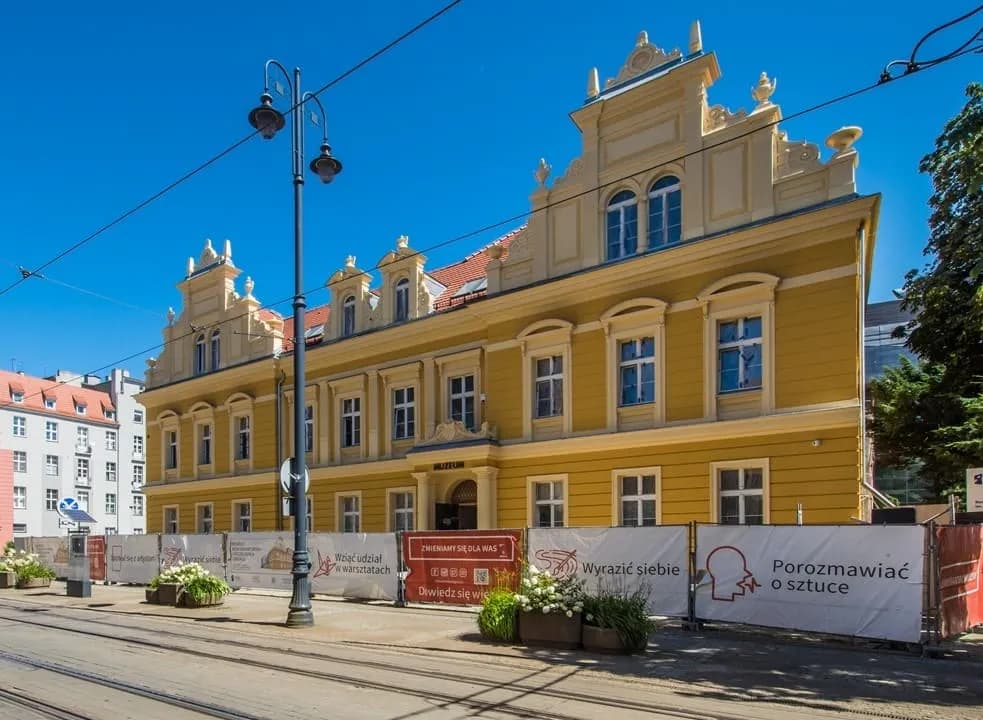
The transformation of the main building at Gdańska 4 added another chapter. After being closed for 12 years because of its technical condition, the historic building underwent conservation, renovation and expansion before reopening in 2021. The project created new possibilities for presenting the collections while retaining the historic character of the building.
Then there is the Exploseum.
Opened in 2011, the branch occupies seven buildings of the former DAG Fabrik Bromberg in the Bydgoszcz Forest. Rather than separating industrial history from the wider museum story, Exploseum demonstrates how the institution has expanded its idea of heritage. Its exhibitions examine the production of explosives, industrial technology, the history of weapons and the forced labour used in the factories of the Third Reich.
The result is a striking contrast with the museum's earliest home. From a small collection displayed above a former church that served as a fire station to a museum network stretching across Bydgoszcz, the institution's history mirrors the city's own changing relationship with its past.
That may be the most revealing part of the story. A museum does not simply preserve history in one place. In Bydgoszcz, it has repeatedly moved, expanded and adapted as new objects, buildings and chapters of the city's past have come to light.
The museum celebrated its centenary in 2023, marking 100 years since the Municipal Museum opened at Stary Rynek 2. Yet its deeper history reaches back to those first public displays of 1890. More than a century later, the same basic idea remains: that understanding a place begins with paying attention to what has survived, what has been lost and what is still waiting to be discovered.
Visitor Information
Muzeum Okręgowe im. Leona Wyczółkowskiego w Bydgoszczy
Gdańska 4, Bydgoszcz
The museum's official website provides current opening hours, admission information and details for individual branches.