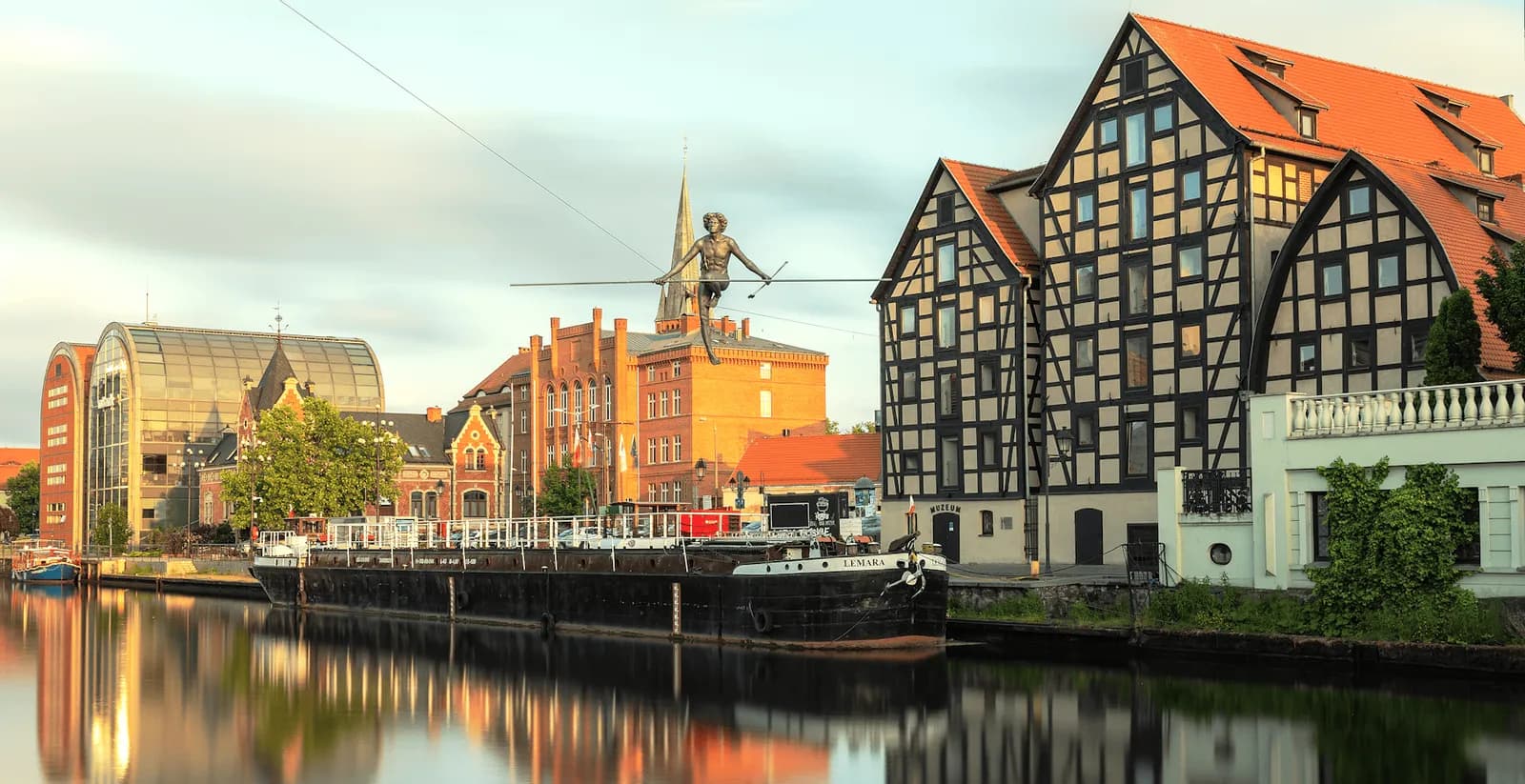
Few buildings capture the character of Bydgoszcz as well as its granaries. Standing along the Brda River, these warehouses reflect the city’s long relationship with trade, waterways and industry. The familiar timber-framed buildings beside Grodzka Street are among the most recognisable sights in Bydgoszcz, but the story does not end with the historic spichrze.
Nearby, modern glass buildings from the 1990s reinterpret the same idea for a new era, creating an unusual architectural conversation between the past and present.
Together, the granaries show how Bydgoszcz has always been shaped by the river.
A City Connected by Grain, Rivers and Trade
The importance of Bydgoszcz’s granaries began with geography.
Located between important waterways, the city became a key point for transporting goods between central Poland, the Vistula River and Gdańsk. Grain from surrounding agricultural regions was brought to Bydgoszcz, stored in riverside warehouses and then transported onwards by boat.
The opening of the Bydgoszcz Canal in the 18th century strengthened this role, linking the Brda and Vistula systems with western European waterways.
The river was not simply part of the landscape. It was the city’s commercial route.
Granaries were built close to the water so that goods could be unloaded directly from boats and stored before continuing their journey.
The Famous Granaries Beside the Brda
The three historic granaries at Grodzka Street 7, 9 and 11 are the buildings most closely associated with Bydgoszcz.
Originally, there were more warehouses in this area. The surviving buildings are the remains of a larger riverside commercial complex that once included additional granaries near Rybi Rynek.
The oldest surviving building, at Grodzka 7, dates from 1793. The other two were constructed at the beginning of the 19th century.
Their traditional half-timbered construction, with wooden frames filled with brick, reflects the practical architecture of the period. They were designed as working buildings rather than decorative landmarks.
Their location tells the story of their purpose. The granaries stood directly beside the Brda because the river was the easiest way to move heavy goods.
From Warehouses to Museum Spaces
As transport methods changed, the role of the granaries changed too.
The growth of railways reduced the importance of river transport for commercial goods, and the old warehouses gradually lost their original function.
Instead of disappearing, the historic buildings found a new role. Today, the Grodzka granaries form part of the Muzeum Okręgowe im. Leona Wyczółkowskiego w Bydgoszczy complex, housing exhibitions connected with the history and culture of the city.
Visitors can explore collections that tell a much wider story of Bydgoszcz, from everyday life and crafts to art and local traditions.
It is certainly fascinating to see a building once used to store grain now preserving the memory of the people and industries that helped shape the city.
Wyspa Młyńska and the White Granary
Another important building is the Biały Spichrz (White Granary) on Wyspa Młyńska.
Built after 1789, it is one of the oldest surviving buildings on the island’s historic industrial site. Unlike the riverside Grodzka granaries, it was closely connected with the mills operating on Wyspa Młyńska. The building served as a grain store and trans-shipment warehouse for the nearby milling industry. Remarkably, it continued to be used for grain storage until 1974.
Today, it has a completely different role, housing archaeological collections and forming part of one of Bydgoszcz’s most popular cultural areas. The transformation of Wyspa Młyńska from industrial centre to public space is one of the most successful examples of heritage regeneration in the city.
The Red Granary That Was Never a Granary
One of Bydgoszcz’s most interesting historical details is the Czerwony Spichrz (Red Granary) on Wyspa Młyńska.
Despite its name, the building was not originally a granary. Constructed in 1861, it was built as a steam mill. Its red brick appearance later gave it the name by which it is known today.
The building is now part of the city’s cultural landscape and houses the Gallery of Modern Art. It serves as another reminder that historic names often preserve memories of places, even when the original function has changed.
The Glass Granaries: A Modern Tribute to the Riverfront
The story of Bydgoszcz’s granaries continued in the 1990s with the creation of the Szklane Spichrze (Glass Granaries).
Built between 1995 and 1998, the buildings were designed by architects Andrzej Bulanda and Włodzimierz Mucha. Created as office buildings for BRE Bank, they became one of the most recognised examples of contemporary architecture in Bydgoszcz.
Their design refers directly to the historic granaries nearby.
The architects used:
tall, narrow proportions inspired by traditional warehouses
brick elements connecting them with older buildings
large areas of glass representing a modern interpretation of the riverside workplace
The result is not a copy of the old granaries, but a conversation with them.
The buildings became an important symbol of Bydgoszcz’s transformation in the years after 1989, when many Polish cities were looking for new ways to combine heritage with modern development.
A Waterfront Shaped by Different Generations
Walking along the Brda today, it is possible to see several centuries of Bydgoszcz’s history in one view. The wooden frames of the 18th-century granaries represent the era of grain trade and river transport. The brick warehouses and industrial buildings recall the city’s manufacturing past. The Glass Granaries reflect the move towards offices, services and a renewed relationship with the waterfront.
This combination is one of the reasons the Brda riverside feels so distinctive. The city has not replaced its past. Instead, different layers of Bydgoszcz remain visible alongside each other.
Exploring Bydgoszcz’s Granary Heritage
A walk through the city centre offers a compact route through this history.
Places worth visiting include:
Grodzka Street granaries beside the Brda River
Wyspa Młyńska with the White Granary and Red Granary
the riverside area near Stary Port
the Glass Granaries, showing the modern continuation of the city’s architectural tradition
Together, these buildings reveal a city shaped by movement: boats carrying grain, merchants building warehouses, industries developing around water and modern architects finding new ways to reference the past.
The granary has become one of Bydgoszcz’s most recognisable symbols because it represents something fundamental about the city: its connection with the river.
image credit: Mariusz Guć, CC BY-SA 4.0